Target / Fluid Energy Jet Mill
Target Jet Mill
Dewei target jet mill: high-speed gas carries the feed onto a wear-resistant target, where impact, rebound and particle collisions produce fine powder. Target, liner, collection and controls are configured for the material.
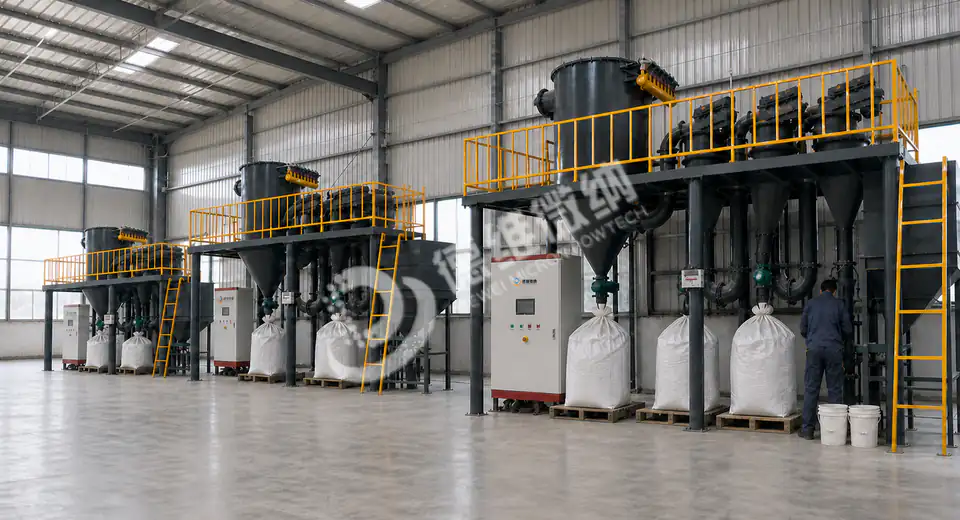
A high-energy impact zone formed by the gas jet
High-speed gas carries the material onto a wear-resistant target. Head-on impact, rebound and particle-to-particle collisions complete the grinding, which suits fine grinding where stronger impact energy and contamination control are needed. The target, nozzles, liner and collection system are matched to material hardness, purity and the target particle size.
- Grinding method: jet-carried impact, reinforced by the target.
- Key configuration: nozzles, target and liner, chosen for wear and purity.
- System boundary: gas supply and collection matched to capacity; particle size (D50/D97) confirmed by trial.
Working Principle
Process Flow
Material Entrained
Primary Breakage
Chamber Walls
Collection
Key Features
Reinforced Impact Grinding
High-speed gas carries the material straight onto the target; rebound and particle collisions continue the size reduction.
No Mechanical Rotor in the Grinding Zone
Grinding energy comes from the gas jet, reducing the contamination risk from mechanical drive parts taking part in grinding.
Configurable Target and Nozzles
Target geometry, nozzles and contact materials are matched to material hardness, abrasiveness and purity requirements.
Controllable Temperature Rise
Grinding is driven by high-speed gas, making the route worth trial evaluation for materials sensitive to process temperature.
Coordinated Collection System
The mill is matched with the gas supply, cyclone collection, dust filtration and controls to balance recovery and stable operation.
Trial Data First
Before final selection, particle-size distribution, capacity, wear, temperature rise and recovery are confirmed with the actual material.
Applications by Industry
| Industry / Use | Typical Materials | Parameters to Share |
|---|---|---|
| Fine Chemicals | Pigments, additives, catalysts and functional powders | Hardness / agglomeration / temperature rise / target size |
| High-Purity Materials | Ceramics, electronic materials and low-metal-contamination powders | Purity / contact materials / wear / recovery |
| Minerals & Inorganic Powders | Brittle materials of medium to high hardness | Mohs hardness / feed size / target life |
| Process Validation | Materials where target materials, air pressure and grinding results need comparison | D50 / D97 / capacity / specific energy |
Model Specifications
The figures below are reference values for typical materials. Actual capacity varies with material density, hardness, and target particle size.
| Model | Ref. Capacity | Product Size | Feed Size |
|---|---|---|---|
| DWJ-30A | 200–500 kg/h | D90 10–75 µm | ≤10 mm |
| DWJ-60A | 400–800 kg/h | D90 10–75 µm | ≤10 mm |
| DWJ-100A | 800–1200 kg/h | D90 10–75 µm | ≤10 mm |
| DWJ-200A | 1500–2000 kg/h | D90 10–75 µm | ≤10 mm |
| DWJ-300A | 2000–2500 kg/h | D90 10–75 µm | ≤10 mm |
Request a Selection Proposal
Tell us your material, target particle size and capacity. We will recommend a suitable configuration of mill, classifier, collection and controls.
- Material name, hardness, density, moisture and tendency to agglomerate
- Target D50, D90, D97, span or residue specification
- Hourly capacity, batch size and continuous-operation needs
- Any cleanliness, inert gas, explosion-protection or low-contamination requirements
Contact Us
Submit the material name, target fineness and approximate capacity. We will reply with a selection recommendation.
Online Inquiry Arrange Sample TestingPhone: +86-816-2680206
Frequently Asked Questions
Can a model be selected from the target particle size alone?
We do not recommend relying on one particle-size value. Hardness, density, feed size, moisture, temperature rise, recovery and contamination control all affect the equipment configuration.
Why is a trial recommended first?
Powders differ widely. The same model can give clearly different capacity and particle-size distribution on different materials, so trial data is more reliable.
Can it be built into a complete production line?
Yes. The main mill can be combined with a classifier, feeding, collection, dust filtration, inert gas protection and PLC controls according to the process target.
What information should an inquiry include?
Please provide the material name, feed size, target particle size, capacity, cleaning requirements, safety requirements, and whether a trial is needed.
 Scan with your phone to start a chat