Morphology adjustment
Controlled shaping improves particle roundness for suitable graphite materials.
Particle Shaping
Particle shaping and classification equipment for graphite anode and carbon materials where morphology, fine-powder control, and product yield matter.
Process Overview
The shaping route applies controlled mechanical action to round and compact graphite particles. Classification and collection remove or recycle fines, while operating parameters are balanced against tap density, morphology, yield, and capacity targets.
Final configuration is determined from representative powder data, required product quality, throughput, operating environment, and safety information.
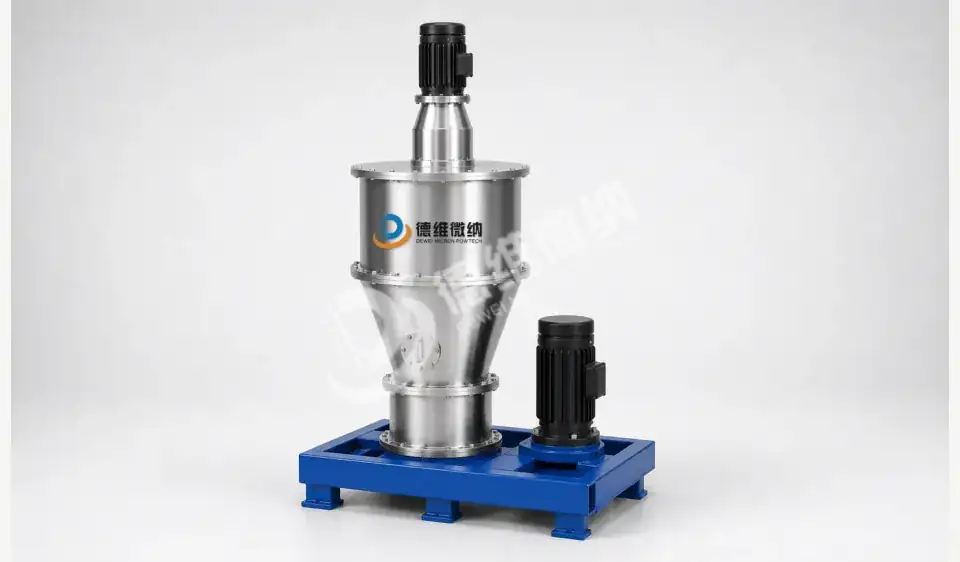
Each item is reviewed against the real powder and acceptance criteria.
Controlled shaping improves particle roundness for suitable graphite materials.
Classification and collection help control excessive fines.
Recycle and staged processing can be evaluated to balance quality and recovery.
Contact materials are selected according to purity and abrasion requirements.
Feeding, shaping, classification, collection, and controls form a complete route.
Microscopy, PSD, tap density, and yield data guide scale-up.
Natural graphite, artificial graphite, carbon materials, and selected anode powders requiring morphology improvement and fine-particle control.
Application examples are not a guarantee for an untested powder. Chemical compatibility, dust risk, and required product properties must be confirmed first.
Send the material name, SDS, feed PSD, target D50/D90/D97, capacity, impurity limits, temperature limit, and atmosphere requirements.
Submit Material Data| Factor | Typical Requirement | Engineering Note |
|---|---|---|
| Main output | Shaped particles | Morphology target by test |
| Control indicators | PSD, tap density, yield | Use agreed methods |
| System modules | Shaping, classifying, collecting | Multi-stage option |
| Scale-up basis | Representative trial data | Feed consistency matters |
No. Feed morphology, particle size, structure, and target properties determine whether shaping is effective.
The process route, classification boundary, recycle strategy, and operating intensity are optimized together.
Provide feed and target PSD, microscopy, tap density, yield target, capacity, impurity limits, and sample quantity.
Testing helps establish achievable particle size, capacity trend, collection behavior, contamination risk, and the correct system boundary before production selection.
Scan to add WeChat
 Scan with your phone to start a chat